
Architects of the Next Economy
Building the global economy of tomorrow is no longer a matter of simply expanding physical borders; it is about the rapid integration of technology into the very systems that sustain human life. From the way we grow our food and manage our health to how we move goods and money across oceans, a fundamental shift is occurring. Startups have transitioned from being secondary players to becoming the primary architects of a new, global digital infrastructure.
In 2024 and 2025, the global startup ecosystem reached a pivotal maturity. While the “growth-at-all-costs” era has faded, it has been replaced by a disciplined focus on high-impact sectors.
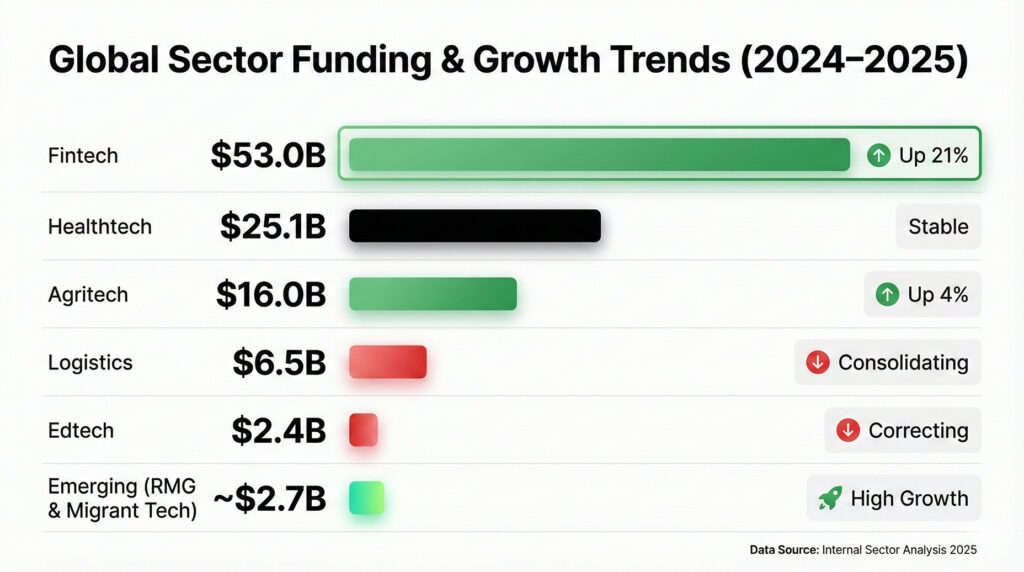
The Global Funding Landscape: 2024-2025
| Sector | Global Funding (2024-25 Est.) | Growth Trend |
| Fintech | $53.0 Billion | 📈 Up 21% |
| Healthtech | $25.1 Billion | ↔️ Stable |
| Agritech | $16.0 Billion | 📈 Up 4% |
| Logistics | $6.5 Billion | 📉 Consolidating |
| Edtech | $2.4 Billion | 📉 Correcting |
| Emerging (RMG & Migrant Tech) | ~$2.7 Billion (Combined) | 📈 High Growth |
Agritech: Resilience Through Data
Agriculture has seen a major 2024-25 shift toward “Climate-Smart” technology. While North America remains the largest beneficiary of funding (capturing nearly 47% of upstream investments), Asia is the most active region for growth.
India has emerged as a global leader in this space, leveraging “AgriStack” and digital public infrastructure to modernize smallholder farming. Indian startups have recently raised over $900 million, with a strong focus on AI-led crop analytics and blockchain traceability. Meanwhile, Europe (led by the Netherlands) has maintained its lead in sustainable food-tech, contributing roughly 32% to global investments.
Fintech: The Global Financial Rail
Fintech remains the heavyweight of the startup world. In 2025, funding surged to $53 billion, driven by a renewed interest in B2B payments and stablecoins. The United States continues to dominate with over $25 billion in activity. Still, the UAE and Singapore have become the new “capital bridges” for the world, funneling billions into cross-border payment systems.
Healthtech and Edtech: Human Capital Engines
Healthtech has moved from “clinical” to “administrative” efficiency. In 2024, nearly 44% of all healthtech funding went into Provider Operations, using AI to manage hospital workflows and patient data. North America leads this sector, while Europe is pioneering personalized medicine.
In contrast, Edtech is in a period of consolidation. The global market has shifted from general online learning to specialized, AI-driven vocational training. Startups that focus on “upskilling” workers for the AI era are the ones capturing the remaining $2.4 billion in VC interest.
Logistics: The Power of Connectivity
The logistics sector is currently undergoing a “SaaS-ification.” Investors are moving away from asset-heavy companies and toward AI platforms that optimize the “last mile.”
- Global Trend: Real-time visibility and route optimization are the new priorities.
- The Bangladesh Example: Multinationals like Lalamove have successfully entered markets like Bangladesh, achieving up to a 52% improvement in delivery efficiency for local SMEs by replacing traditional, inefficient fleets with on-demand, tech-driven booking systems.
The Emerging Frontiers: RMG and Migrant Tech
Two sectors are quietly redefining the “necessity market”: Ready-Made Garment (RMG) Tech and Migrant Tech.
In the RMG sector, the narrative has shifted from labor arbitrage to manufacturing transparency. Startups are building digital workflow tools that allow global brands to track production in real-time, ensuring ethical compliance and reducing waste. This isn’t just about software; it’s about the industrial backbone of nations like Vietnam and Bangladesh becoming tech-enabled.
Parallel to this is Migrant Tech, a sub-sector of Fintech that serves the millions of workers moving across borders. These startups are creating “financial anchors”—mobile-first banking and digital identity tools that allow migrants to carry their credit history and savings across different countries. With players like Uzum in Central Asia becoming unicorns by serving the unbanked, this sector is proving that social inclusion is the ultimate economic multiplier.
Conclusion: A Foundation Built to Scale
The global economy is no longer being built by isolated breakthroughs, but by an interconnected web of startups that treat social and industrial problems as the ultimate market opportunity. By aligning profit with systemic problem-solving—whether through food security in India or logistics efficiency in Bangladesh—these companies are laying a foundation that is adaptive, data-driven, and built for sustainable scale. The future is no longer under construction; it is already operating on these new digital rails.